

Just received your ERAS token? Congratulations: this is the first significant step toward applying for residency in the U.S. Whether you’re a U.S. graduate or an international medical graduate (IMG), now is the time to build a competitive residency application that stands out. Here’s how to get started.
1. Register on MyERAS
Use your ERAS token to create your MyERAS account.
Choose the correct application season, confirm your details, and start entering your information. You’ll be able to upload documents, track progress, and manage your application all in one place.
2. Fill Out Your ERAS Application
Carefully complete all sections, including:
-
Education and training history
-
Clinical experience (U.S. and international)
-
Work, volunteer activities, and research
-
Publications and presentations
Avoid typos and inconsistencies—this is your professional profile. Be thorough but concise, and don’t repeat information across sections.
3. Write a Compelling Personal Statement
Your personal statement is one of the most important parts of your residency application. It should:
-
Be tailored to each specialty you’re applying to
-
Explain your journey to medicine and specific interest in the specialty
-
Highlight what makes you a good fit
-
Avoid generic language. Focus on authenticity, clarity, and relevance.
Get started with your personal statement here Personal Statement Editing
4. Polish Your ERAS CV
Format your CV to highlight clinical experiences, leadership, teaching, and achievements. Include:
-
Specific roles and responsibilities
-
Names of hospitals/clinics
-
Relevant dates and outcomes
-
Show how your experiences align with your career goals and specialty interests.
5. Request Letters of Recommendation Early
Reach out to attendings or mentors who can speak confidently about your clinical skills, professionalism, and work ethic.
-
Aim for 3 to 4 strong letters
-
At least two should be from someone in your target specialty
-
Guide letter writers on uploading via the ERAS Letter of Recommendation Portal
-
Give your writers enough time and provide helpful context about your goals.
For reapplicants, you can transfer your letters from the previous cycle or request an updated letter from your attending physician.
6. Research and Build Your Program List
Use tools like FREIDA, Residency Explorer, and AAMC to build a list of programs that match your credentials and goals.
Consider:
-
Program requirements (USMLE scores, year of graduation,
-
visa sponsorship for IMGs)
-
Location and work-life balance
-
Program culture and resident feedback
-
Create a spreadsheet to organize deadlines, requirements, and program notes.
7. Set a Timeline for Completion
Time management is key. Set weekly goals to avoid last-minute stress. For example:
-
Week 1: Personal statement draft
-
Week 2: CV formatting and edits
-
Week 3: Finalize and request LoRs
Aim to submit your application early in September, ahead of peak volume.
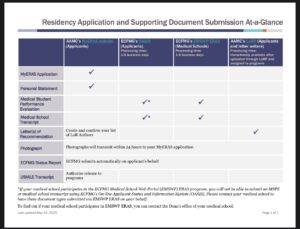
8. Upload Required Supporting Documents
Make sure all documents are ready to go:
-
Medical school transcript
-
MSPE (Dean’s Letter), usually uploaded by your school
-
USMLE transcript (requested through MyERAS)
-
ECFMG certification (for international graduates)
9. Prepare for Residency Interviews
Start early with your interview prep. Practice answering common questions and behavioral scenarios.
-
Be ready to discuss your strengths, clinical experiences, and any gaps
-
Learn how to present yourself professionally in virtual interviews
-
Research interview formats and expectations for each specialty
Residency Interview Preparation
Need Help Getting Started?
Applying for residency can be overwhelming, but you don’t have to do it alone. Get personalized guidance on:
-
Residency application strategy
-
CV and personal statement editing
-
Interview preparation and IMG-specific tips
- Repplicant strategies
Explore how we can help you here on Services for expert residency tips, or connect with https://www.fiverr.com/juinmd?public_mode=true for one-on-one coaching and residency application review.